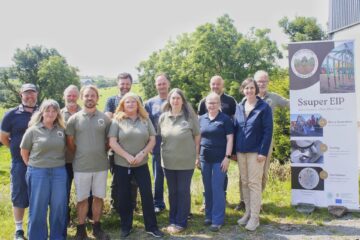
Project Manager Denise Moran
My name is Denise Moran and I Farm alongside my husband Richard in Abbeyshrule Co. Longford. We have a traditional mixed farm, with woodland. We are certified Organic, following regenerative and agroecological principles in how we farm
What does that mean?
Agroecology is both the science and practice of farming in harmony with nature. It promotes diversity, resilience, recycling, efficiency, co-creation, sharing of knowledge and responsible governance and circular economies. It provides a practical, evidence-based pathway towards food sovereignty
Food Sovereignty not food security!
In practice, this means reducing dependency on external inputs, regenerating ecosystems and giving farmers and communities greater control over their food systems. Regenerative farming restores soil health and ecosystem resilience by:
- minimizing soil disturbance,
- keeping the ground covered,
- maintaining living roots,
- maximizing plant diversity,
- integrating livestock,
- adapting to local context.
The good news is that more and more farmers are moving in this direction. But it needs to go Mainstream.
How do we do this?
For Instance, conferences like this one, events outside of our control, the War in Ukraine, the first big impact on diesel and fertilizers costs, five years on, now a bigger hit with the war in the Middle East and the Closure of the Straits of Hormuz, the dramatic real time effects of climate change which we are all been affected by, especially farmers, with the big fluctuations in our weather and the sudden and unpredictable changes of the GeoPolitical landscape, which threatens the established world order……. All of which has woken us up to the harsh reality, that for too long we have coasted along in a First World Bubble of Comfort and
that Bubble has now started to disintegrate. We need to pay attention and make very necessary changes, while we can. Lots of small changes together can have big impacts.
Here’s one that I believe can contribute
The EU is not perfect but it does get some things right, and one of them is The European Innovation Partnership Scheme or EIP for short, It is a scheme that funds collaborative, bottom-up projects that unite farmers, researchers, and agronomists to trial practical solutions for agricultural sustainability and resilience. I am the Project manager of one such EIP, and it’s a project on something that I as a Farmer do not produce, slurry.
Who doesn’t know about Slurry? We have all been impacted in many ways by it: the smell, the run off into our waterways, fish kills, to name but a few. Because we now produce so much slurry, even though it has nutrient value, it has become for farmers and regulators alike more of a waste management issue.
Is slurry the problem or it is how we manage it?
Slurry management has become a pressing concern for farmers, environmental regulators and local communities. Current practices in dealing with slurry have had and continue to have significant negative impacts on water quality, soil health and emissions, leading to serious long-term consequences for both farming operations and the environment. This project sets out to address these issues by implementing innovative, sustainable practices to transform slurry management, improve environmental outcomes and enhance the sustainability of Irish farming. We aim to maximise slurry as a very valuable on farm resource.
Throughout history manure has always been the main source of nutrient input for our soils in its solid form both directly y the animal or via mixed bedding when animals were housed. Then along came chemical inputs and FYM started to be seen as more of a waste product, piled up in a corner to “rot down” or given away to get rid of it. Somewhere along the way some bright spark thought, I know lets build a big underground tank, make a slatted floor, house our animals on it and hey presto, no more bedding required, no more dung heaps, and the consequence, the production of slurry, in ever increasing amounts because with slatted tanks came the growth in Intensive farming systems and all its inherent problems. Slurry has always bothered me, for all the reasons mentioned, and then in 2023 I found out about slurry separation, a process that separates the slurry into two fractions, liquid and solids.
I thought this was ingenious, and new, but not so. Slurry separators have bee around since the 80s but went mainstream in Europe in the early 2000s due the Nitrates Directives so why not here in Ireland? I then found out that there is a 60% TAMs grant available to Farmers to buy a separator, but it is proving to a tough sell. Why, for many farmers it means taking one problem and making it into two and most farmers simply don’t know what to do with the solid dry matter. Why, because we have lost touch with our understanding of what the dry matter is, and that is organic matter: the life blood of our soils.
This is the missing key inout for thriving fertile functioning soil. Its not the expensive, external, imported Chemical N P & K that several generations of farmers have been led by the nose, by vested interests, to believe, it is the good old Farmyard Manure, and everything else in the detritus sphere, that space just above the top of the soil where Macro Arthropods, spiders, creepy crawlies, dung beetles, earthworms etc feast on fallen leaves, poop, dead bodies, insect and animal, and turns it all into humus rich layer, to feed the microbes beneath, and drive a healthy functioning soil food web, that in turn, mines the NP& K already available in the soil, subsoil and bedrock.
Fast forward to 2024, a Call goes out for new EIPs and having been part of a Talamh Beo EIP on Soil Biodiversity, my first thought was to apply for a project to follow on from the lessons learnt on that, but the Slurry Devil on my shoulder thought otherwise, and here we are the Slurry Solutions or SSuper EIP was born.
Based on the Separation of Slurry as a very important first step, we decided to take a more
holistic view, and built the project around SIX PILLARS
- Separate: Implement advanced slurry separation technologies to divide slurry into
distinct components, improving storage and application efficiency. - Inoculate: Use biological inoculants to promote healthy soil microbiology, enhancing
nutrient cycling, reducing the need for chemical inputs whilst reducing greenhouse
gas emissions. - Regenerate: Focus on regenerative farming practices that enhance soil health,
biodiversity and restoring ecosystem services through improved slurry management. - Evaluate: Continuously assess the effectiveness of slurry separation, biological
inoculants and soil functionality, whilst refining techniques to improve farm
sustainability and environmental performance. - Educate: Equip farmers with the knowledge and skills necessary to implement these
regenerative practices on their farms. - Disseminate: Share knowledge and best practices with the broader farming
community, encouraging collaboration and peer-to-peer learning.
Part of our evaluation process, is the use of regenerative soil microscopy and DNA sequencing of both the farmers soils and slurry. We will then test a range of biological inoculants to measure their effects on both fractions of the slurry and subsequently on the
soil. By focusing on these six pillars, the project aims to create a regenerative, circular farming system adaptable to both intensive and small scale farms where slurry is viewed as a valuable resource that benefits both the environment and farming communities.
A successful EIP is one that delivers its objectives, but more importantly, in a way that can be upscaled and integrated across all farming systems. We will working with 18 farmers over the life of the project from large scale Dairy farms, to beef enterprises, 365 indoor systems both Conventional and Organic, and if our first six farmers that we are currently working with are anything to go by, it bodes well for the future of farming here in Ireland. The level of engagement by the farmers and the readiness to learn and adopt, new principles and practices that protect the soil and environment is very heartening.
Somewhere in the past, we went from being Farmers in touch with our land, our communities and Nature . We lost faith in our inherent knowledge to farm as caretakers of the soil and our environment and We got caught up in an export driven, globalised
agricultural system, and became Agri-Businesses, in pursuit of progress, modernisation, and the bottom line. I don’t think that these two opposing philosophies need be entirely incompatible and I think that our Farmers enthusiasm for the Project, may well bear this out.
At its heart, farming is an act of care.
Care for the soil that feeds us.
Care for the animals entrusted to us.
Care for water, biodiversity and the landscape.
Care for families, neighbours and communities.
And care for future generations, who will inherit the land after us.